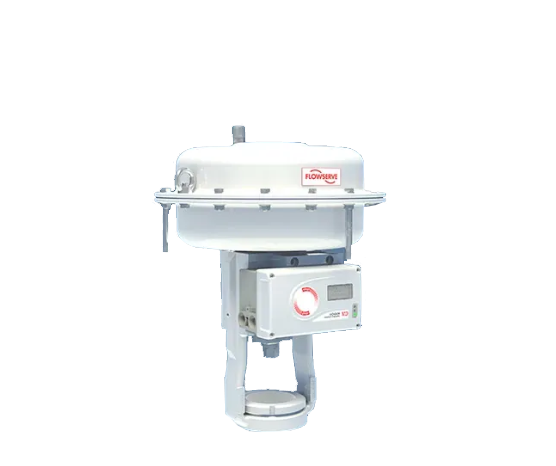
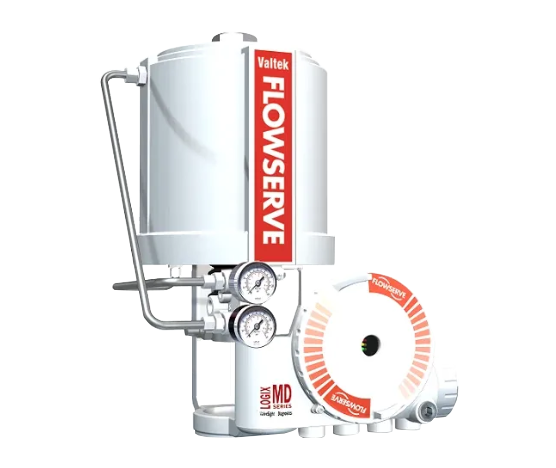
•Multiple Positioners and Controllers — A variety of positioner/controller options makes the spring cylinder actuator ideal for numerous control requirements.
•High Frequency Response — Double-acting configuration responds quickly to signal changes.
•Dynamic Positioning Accuracy — Supply pressure is modulated to both sides of piston for stiff, precise actuator operation; small air volume between the piston and the bottom of the cylinder provides powerful pneumatic stiffness, allowing a high pressure drop—without plug slamming.
•Low Air Consumption — Cylinder design uses less supply air than comparable diaphragm actuators.
•High Thrust Capability — 150 psi (10.3 bar) operating pressure allows substantially higher thrust capabilities than comparable diaphragm actuators. Higher thrust allows tighter valve shutoff.
•Longer Stroke — Longer strokes provide better process control. Size 25 spring cylinder linear actuators have a 1½ inch (38 mm) stroke, in contrast to a ¾ inch (19 mm) stroke on a comparable linear diaphragm actuator. Larger actuators have similar comparisons; stroke lengths are available up to 24 inches.
•Fail-Safe Spring — Internal spring provides fail-safe operation in the event of air system failure. Spring bench set is not required.
•Compact and Light-weight — For easier installation and maintenance, spring cylinder linear actuators are substantially lighter and more compact than comparable linear diaphragm actuators
•Simple Maintenance — Periodic maintenance is easy to perform since the spring cylinder actuator only requires the removal of three parts to access all internal parts
•Durable Components — High-quality materials require little maintenance. There is no diaphragm to rupture
•Wide Range of Sizes — Standard actuator sizes 25, 50 and 100 will handle thrust requirements for over 95% of process applications; larger sizes through size 600 are available for special applications.
•Fewer Parts — Spring cylinder linear actuators have one-third the number of parts as diaphragm linear actuators; wear parts cost 10 percent of those for diaphragms, and less inventory is required to maintain actuators
•Field Reversible — Failure mode is easily reversed without additional parts. Reduces inventory costs
•No Pressure Regulator Required — Cylinder actuators easily handle air supplies up to 150 psi (10.3 bar) without a pressure regulator and can be operated with as little as 30 psi (2.1 bar)*. (* Operating pressure on some sizes is limited because of valve sizes.)